Balls and Nets
Pickleball Net Height and Setup, Measured the Right Way
Use this pickleball net height and setup guide to measure 36 inches at the sidelines, 34 inches at center, and fix common setup issues.
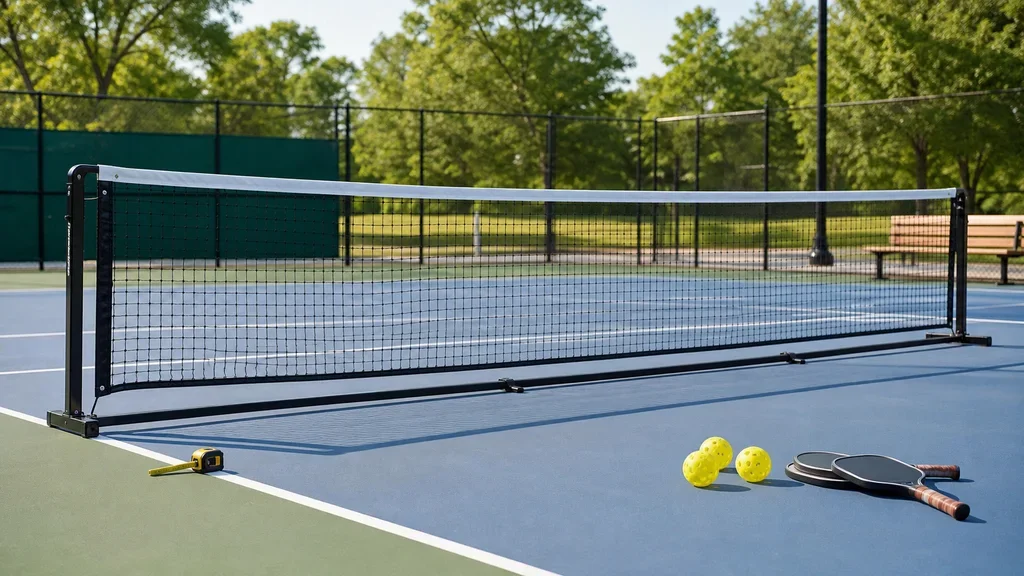
If you are setting up a driveway game, a club court, or a portable net at the park, pickleball net height and setup comes down to three numbers: 36 inches at each sideline, 34 inches at the center, and 22 feet between the inside faces of the posts. Get those right first, then worry about tension, center sag, and whether the net is square to the court.
Small errors matter more than most beginners expect. A net that is one inch high in the middle makes drops and dinks feel harder than they should; a loose portable net can sag so much that drives clear the tape too easily.
| What you see | Likely cause | First move |
|---|---|---|
| Center tape sits higher than 34 inches | Net is over-tensioned or the center strap is not set | Measure the middle, then loosen tension before adjusting the strap |
| Ball rolls under the bottom edge | Portable frame is twisted or the mesh is not seated | Square the frame and reattach the lower net sleeves |
| One sideline is taller than the other | Uneven surface or one post is leaning | Measure both sidelines and reset the post feet |
| Net bows toward one side | Frame is not centered on the court line | Align the center of the net with the centerline before tightening |
| Kitchen rallies feel oddly easy over the middle | Center sag is below regulation height | Raise the center strap until the tape reaches 34 inches |
Pickleball Net Height and Setup Measurements
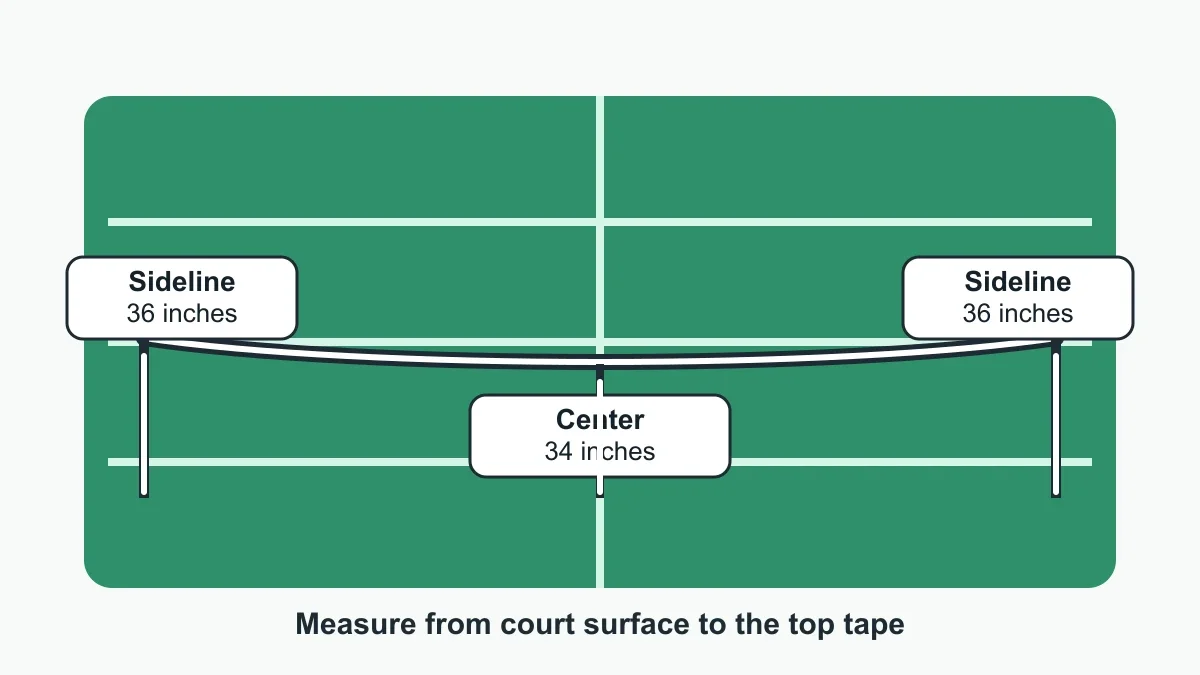
Start at the top tape, not the mesh below it. USA Pickleball specifies the top of the net at 36 inches, plus or minus 0.25 inch, where the net crosses each sideline. At the center point, the top of the net should be 34 inches, plus or minus 0.25 inch.
That two-inch drop is intentional. Pickleball rewards safe shots through the middle because the lowest part of the net sits there, while the sidelines ask for a little more clearance.
For a full court, the inside faces of the posts should be 22 feet apart. Since a pickleball court is 20 feet wide, that places each post about one foot outside the sideline. Portable nets often approximate this layout with a frame that spans the court plus a little overhang.
What to Measure Before You Play
Use a tape measure, a net-height gauge, or a marked stick. A phone app is not accurate enough here because you are checking a real physical height, usually on a surface that may not be perfectly flat.
- Find the sideline crossings. Measure where the net crosses the outer edge of each sideline, not at the very outside of the post.
- Check both ends. Each sideline should read 36 inches at the top tape.
- Move to the center. The center point is 10 feet from either sideline on a standard 20-foot-wide court.
- Set the center height. Adjust the center strap or portable frame until the top tape reads 34 inches.
- Look across the tape. The top line should sag evenly, not dip hard on one side.
Want the rest of the court to feel organized too? Pair the net check with a basic beginner pickleball set, a few reliable outdoor pickleball balls, and a simple beginner pickleball bag so the measuring tape, spare balls, and line markers are not scattered everywhere.
Portable Net Setup Without the Wobble
Portable nets are convenient, but they are also where setup mistakes show up fastest. Assemble the frame on the court before pulling the net tight. If you tension the mesh while the feet are still crooked, the whole unit can twist and the center height will keep drifting.
Set the frame so the net line runs straight across the middle of the court. Then attach the mesh evenly from both ends, seat any sleeves or Velcro tabs, and only then tighten the center strap. The last move should be measurement, not guesswork.
A sagging center is not always a bad sign. Regulation pickleball expects the middle to be lower than the sidelines. The problem is uneven sag, loose bottom mesh, or a center reading that lands well below 34 inches.
Permanent Net Details That Beginners Miss
Permanent courts are easier once they are installed correctly, but they still need checks. Cable tension, center straps, and post caps take weather and regular play. A court can look official and still be off by enough to change your practice rhythm.
On a permanent net, do not crank tension until the center rises to the sideline height. That flattens the net and removes the intended two-inch drop. Adjust the strap so the middle sits at 34 inches while the sidelines stay at 36 inches.
Post diameter also matters for regulation construction. USA Pickleball lists net posts as no more than 3 inches in diameter, with the net long enough to span from post to post and prevent a ball from passing through the mesh.
Why Net Height Changes Your Shots
Net height is not just a setup chore. It shapes how you learn the game. If you practice drops over a center that is too high, you may start hitting with extra lift. If the center is too low, your drives and speedups can seem cleaner than they really are.
That is why players working on a beginner serve routine, home drills for beginners, or doubles positioning basics should check the net before blaming their paddle. Setup is part of practice.
Gear still matters, of course. A player moving from tennis may prefer control paddles for tennis players, while a newer player may be comparing paddle weight, beginner spin paddle traits, or a power paddle guide. None of that gives a fair read if the net is wrong.
Common Setup Mistakes and Fast Fixes
Using tennis net habits
A tennis net is not the model to copy. Pickleball uses a lower center, and the sideline height is different from how many casual players remember tennis courts. Measure the pickleball numbers directly.
Measuring at the post instead of the sideline
Post hardware can sit outside the playing line. The meaningful sideline measurement is where the net crosses the outside edge of the sideline.
Ignoring the non-volley zone
Net setup and kitchen play are connected. If the center height is off, dinks around the kitchen rule feel misleading, especially for players also learning the double bounce rule and singles and doubles scoring.
Letting the net drift during play
Portable nets can shift after a few games. Recheck between sessions, especially if players kick balls under the frame or move the unit to clear space.
Simple Buying Notes for Nets and Court Gear
If you are buying a portable net, look for a stable center support, clear assembly markings, and a frame that does not need heroic tension to reach 34 inches in the middle. A net that is easy to measure is easier to keep honest.
A few extras make setup smoother: a compact tape measure, court-line cleaner, spare balls, and a bag pocket that keeps small gear together. The same practical mindset applies to paddles. Keep up with your paddle care routine, understand paddle surface grit, and compare materials with a carbon fiber versus fiberglass paddle guide before chasing upgrades.
Players who want a tighter game after the court is set should also review beginner doubles strategy, common beginner mistakes, how long paddles last, and a control paddle shortlist. A correctly set net makes those lessons easier to trust.
Quick Checklist
- Measure both sideline crossings at the top tape: 36 inches.
- Measure the center point at the top tape: 34 inches.
- Confirm the posts or frame span about 22 feet inside-to-inside on a full court.
- Square a portable frame before tightening the net.
- Use the center strap to set sag, not to over-flatten the net.
- Recheck after moving a portable net or after several games.
- Store a tape measure with your balls and net parts so setup does not become a guess.
Frequently Asked Questions
what is the correct height for a pickleball net?
A pickleball net should be 36 inches high at the sidelines and 34 inches high at the center, measured from the playing surface to the top of the net tape.
how high is a pickleball net in the middle?
The middle of a regulation pickleball net is 34 inches high, with a tolerance of plus or minus 0.25 inch under the current USA Pickleball rulebook language.
is a pickleball net the same height as a tennis net?
No. A pickleball net uses 36 inches at the sidelines and 34 inches at the center. Tennis uses different net geometry, so copying a tennis setup can throw off pickleball practice.
how far apart should pickleball net posts be?
For a regulation court, the inside faces of the posts should be 22 feet apart. That gives one foot of net overhang on each side of a 20-foot-wide court.
do portable pickleball nets meet regulation height?
Many portable nets can meet regulation height if they are assembled squarely and adjusted with the center support or strap. Always measure the two sidelines and the center before play.
Official sources: USA Pickleball Official Rulebook · USA Pickleball court construction guidance.
Measure once before the first game and the rest of the session feels more honest. The net does not need to be fancy. It needs to be straight, stable, and set to the numbers the game expects.