Rules
Pickleball Kitchen Rules Made Clear: The Beginner's Guide to the Non-Volley Zone
Pickleball kitchen rules explained clearly: when you can step in, volley, dink, and avoid non-volley zone faults in real games.
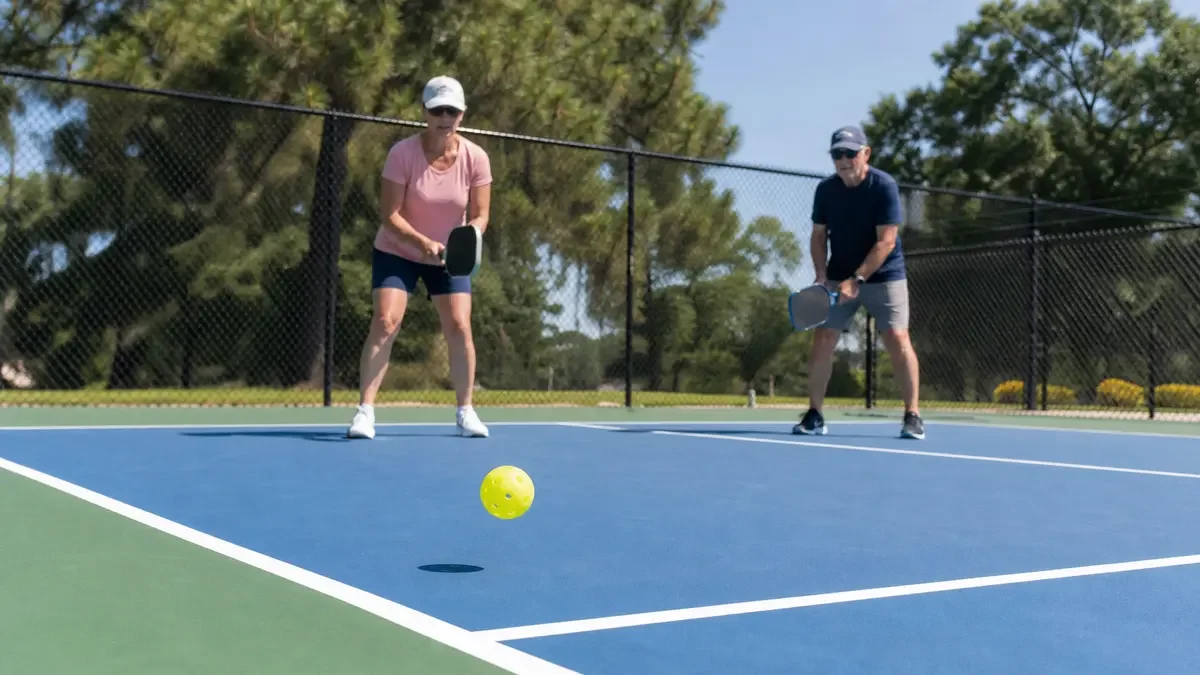
If you want pickleball kitchen rules explained without the arguments, start with one sentence: you can stand in the kitchen, but you cannot volley while touching it. The kitchen is the non-volley zone, and most beginner confusion comes from mixing up a ball that bounced with a ball hit out of the air.
Think of the kitchen as a patience zone. It keeps players from camping on top of the net and smashing every ball downward, which makes rallies fairer and more playable for everyone.
| What you see | Likely cause | First move |
|---|---|---|
| A player steps into the kitchen after a soft shot | The ball bounced first | Usually legal, keep playing |
| A player hits the ball out of the air with a toe on the line | The line is part of the kitchen | Call a non-volley zone fault |
| A volley pulls someone forward into the kitchen | Momentum from the volley carried them in | Call the fault, even if the ball was already dead |
| A player stands in the kitchen waiting | Standing there is allowed | Watch whether the next shot bounces |
| A paddle or hat touches the kitchen after a volley | Anything worn or carried counts | Treat it as contact with the zone |
What the kitchen is and why it exists
The kitchen is the seven-foot area on both sides of the net. Official language calls it the non-volley zone, but players use both names on court.
Volley means hitting the ball before it bounces. So the rule is not really a no-standing rule. It is a no-volleying-from-that-zone rule.
Pickleball kitchen rules explained in plain English
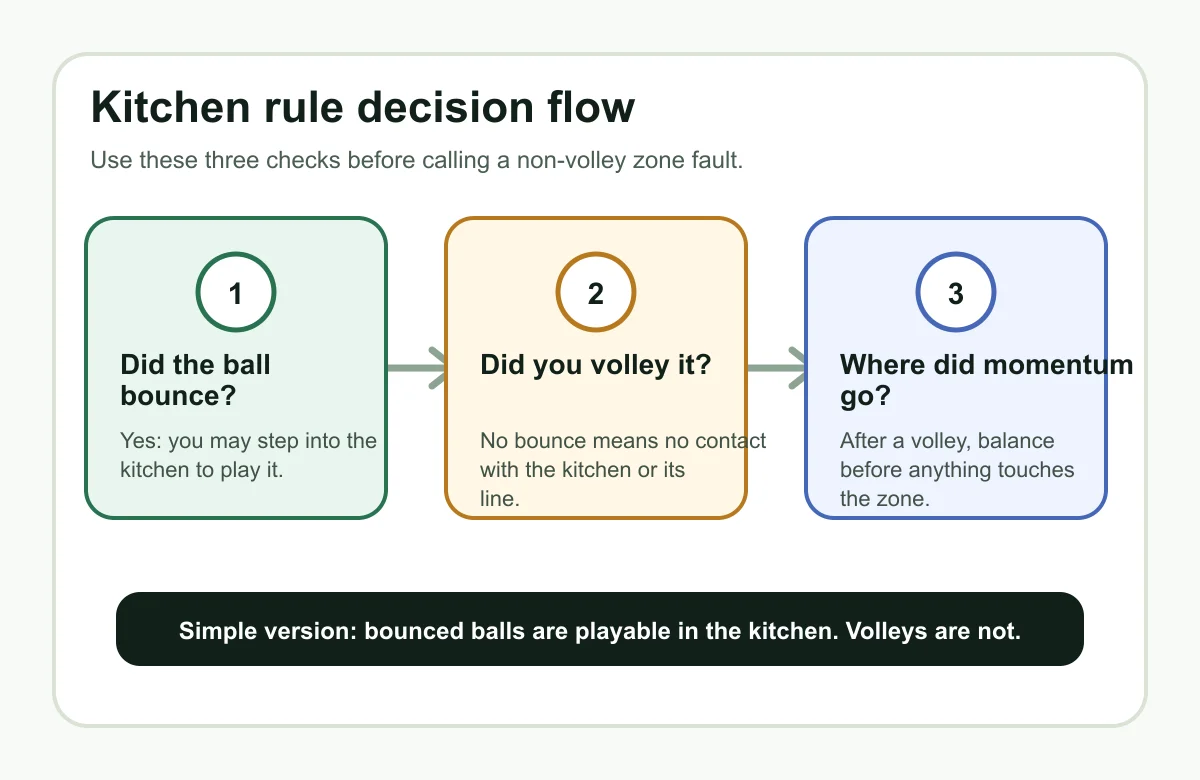
- You may enter the kitchen any time. Walking into the non-volley zone is legal as long as you do not volley while touching it.
- You may hit a bounced ball from the kitchen. Dinks, resets, and short balls are legal there once the ball has bounced.
- You may not volley from the kitchen. No part of your body, paddle, clothing, or anything you are wearing or carrying can touch the zone during that volley.
- Your momentum matters after a volley. If the volley pulls you into the kitchen after contact, it is still a fault.
- You must reestablish outside the zone before volleying. If you step in, get both feet clearly back outside before hitting the next ball out of the air.
That last point is where people usually get it wrong. A player can step into the kitchen, back out, then volley legally, but only after fully reestablishing position outside the zone.
The bounced-ball test solves most arguments
Ask one question first: did the ball bounce before the player hit it? If yes, kitchen contact is usually fine.
Bounced balls are the reason dinking exists. You can step into the kitchen, play the short ball, stay balanced, and recover without breaking the rule.
Confusion often shows up right after the serve and return. The double bounce rule says the serve must bounce and the return must bounce before either team can volley, so a clean beginner serving routine helps the point start without extra rule noise. Once that sequence is done, volleys are allowed, but the kitchen restriction still applies.
Momentum faults are the tricky part
Momentum means the motion from your volley does not stop at contact. If you volley from outside the kitchen and your body, paddle, partner, clothing, or anything you carry touches the kitchen because of that motion, the fault follows you.
Yes, even if the ball lands out. Yes, even if your opponent already missed. The rule cares about whether your volley caused the kitchen contact.
Picture a player reaching forward for a high volley, hitting a clean winner, then taking one extra step onto the kitchen line. That point is not theirs. The volley caused the step.
Legal kitchen plays beginners should use
Dinks are legal because the ball bounces first. A dink is not a loophole. It is the basic kitchen shot.
Use a short backswing, open paddle face, and calm grip pressure. If the paddle feels jumpy, review paddle weight for beginners, control-focused paddles, and how paddle surface grit changes touch and spin.
Players who want more reach at the kitchen should compare the paddle shape guide with the elongated or standard paddle breakdown. Reach helps only if you can still reset the ball softly.
How to stand near the non-volley zone
Stand close enough to pressure short balls, but not so close that your first move is a panic step onto the line. A small buffer behind the line gives your body room to stop after volleys.
In doubles, both partners should understand who covers the middle and who protects the sideline. The guide to beginner doubles strategy goes deeper on positioning, calling balls, and avoiding partner collisions.
Footwear matters here more than beginners expect. If your shoes slide or roll during lateral stops, read pickleball court shoes vs tennis shoes before blaming your paddle or reaction time.
Common calls and what they mean
- Volley with a toe on the line: fault.
- Step in after hitting a bounced dink: legal.
- Drop a paddle into the kitchen after a volley: fault if momentum from the volley caused it.
- Jump from outside, volley, land in the kitchen: fault.
- Stand in the kitchen and let a ball bounce before hitting: legal.
- Reach over the kitchen from outside and volley without touching it: legal if nothing touches the zone.
Scoring does not change the kitchen rule, but it changes who benefits from the fault. If side-outs and server numbers still feel muddy, review singles and doubles scoring.
Practice drills for cleaner kitchen play
- Line-awareness dinks, 5 minutes. Place your toes two inches behind the kitchen line. Dink only after the ball bounces, then reset to the same spot.
- Volley-stop drill, 5 minutes. Stand a step behind the line, block a gentle volley, and freeze your feet before moving forward.
- Step-in, step-out reps, 5 minutes. Step into the kitchen for a bounced ball, then get both feet back outside before the next feed.
- Partner call drill, 5 minutes. One player says "bounce" or "volley" before contact. It trains the rule decision, not just the shot.
For more controlled reps, use pickleball drills at home, pickleball drills for beginners, and a short set of pickleball warm-up exercises before hard games. The related guide to beginner pickleball mistakes also covers rushed feet and overhit kitchen balls.
Gear notes that affect kitchen control
Rules decide what is legal, but gear affects whether you can stop, soften the ball, and keep the paddle face steady. Beginners should prioritize comfort and control over raw power near the non-volley zone.
Start with a paddle you can swing quietly. A best paddle under $100 shortlist can be enough for new players, while a power-friendly beginner paddle only makes sense if you can still dink and block.
Grip and face feel matter too. Check paddle grip size, compare a carbon fiber or fiberglass paddle, and keep the face clean with a basic paddle care guide. If contact suddenly feels dead or erratic, the article on how long pickleball paddles last can help you spot wear.
Quick Checklist
- Remember that the kitchen is the non-volley zone.
- Ask whether the ball bounced before checking feet.
- Treat the kitchen line as part of the kitchen.
- Do not volley while any part of you touches the zone.
- Stop your momentum after a volley before stepping in.
- Get both feet back outside before volleying again.
- Practice dinks and volley-stop drills until the calls feel obvious.
Kitchen rules are easier once you stop treating the zone like forbidden ground. Step in for bounced balls, stay out for volleys, and respect momentum after contact. That simple rhythm clears up most beginner disputes.
Official sources: Rule details were checked against the USA Pickleball Official Rulebook page and the USA Pickleball Rules Summary.
Frequently Asked Questions
Can you stand in the kitchen in pickleball?
Yes. You can stand in the kitchen at any time as long as you do not volley while touching it. If the ball bounces first, you may hit it from inside the kitchen.
What is a kitchen fault in pickleball?
A kitchen fault happens when a player volleys while touching the non-volley zone or its line, or when momentum from that volley causes the player or anything they wear or carry to touch the zone.
Can you step into the kitchen after hitting the ball?
It depends on the shot. If the ball bounced before you hit it, stepping into the kitchen is usually legal. If you volleyed the ball and momentum carried you in, it is a fault.
Is the kitchen line part of the kitchen?
Yes. The non-volley zone line is part of the kitchen. A toe, paddle, or item touching the line during a volley counts as kitchen contact.
Can you jump over the kitchen and volley?
You can volley while airborne only if your takeoff and landing do not create illegal kitchen contact. Jumping from outside, volleying, and landing in the kitchen is a fault because of momentum.