Paddles
How to Find the Right Pickleball Paddle Grip Size Without Guessing
Use this pickleball paddle grip size guide to measure handle fit, test comfort on court, and adjust with overgrips before buying.
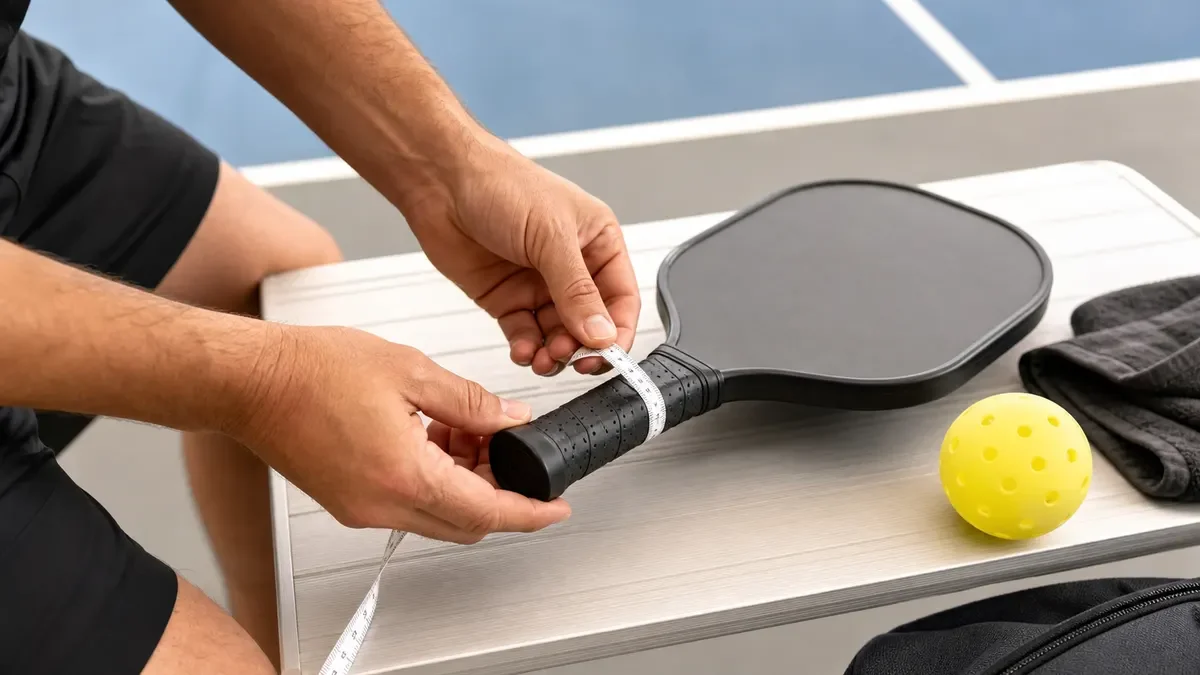
This pickleball paddle grip size guide starts with a simple idea: the best grip is the one you can hold lightly while keeping the paddle face under control. A grip that feels fine in your living room can feel wrong once you dink, block, serve, and reset a few balls.
Start with fit, then test feel. Grip circumference, overgrip thickness, handle shape, paddle weight, and your hand tension all work together, so do not treat one printed number as the whole answer.
| What you see | Likely cause | First move |
|---|---|---|
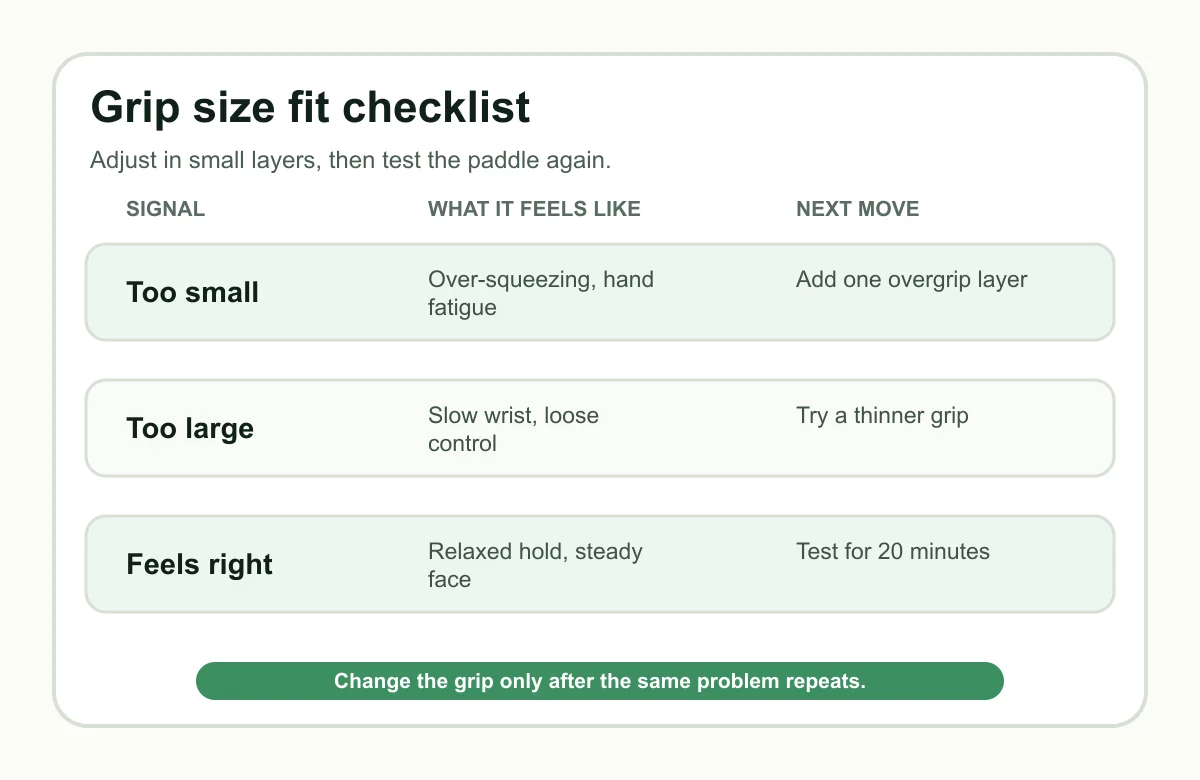
| Your hand squeezes hard by the third game | Grip may be too small, too slick, or too thin | Add one overgrip layer and test again |
| The paddle twists on off-center hits | Grip shape, sweat, or loose pressure may be the issue | Dry the handle and check finger spacing |
| Your wrist feels blocked on serves | Grip may be too large for your hand | Try a thinner replacement grip if possible |
| You cannot relax your fingers at the kitchen | Grip size and paddle weight may be fighting you | Compare grip fit with a lighter paddle |
What you need
- A pickleball paddle you already own or a demo paddle from a shop, club, or friend.
- A soft measuring tape, or a strip of paper and a ruler.
- One clean overgrip, because small changes are easier to test than permanent grip replacement.
- A few balls and 15 to 20 minutes of court time.
- A note on the paddle's listed grip circumference, if the brand publishes it.
Pickleball paddle grip size guide: the quick fit test
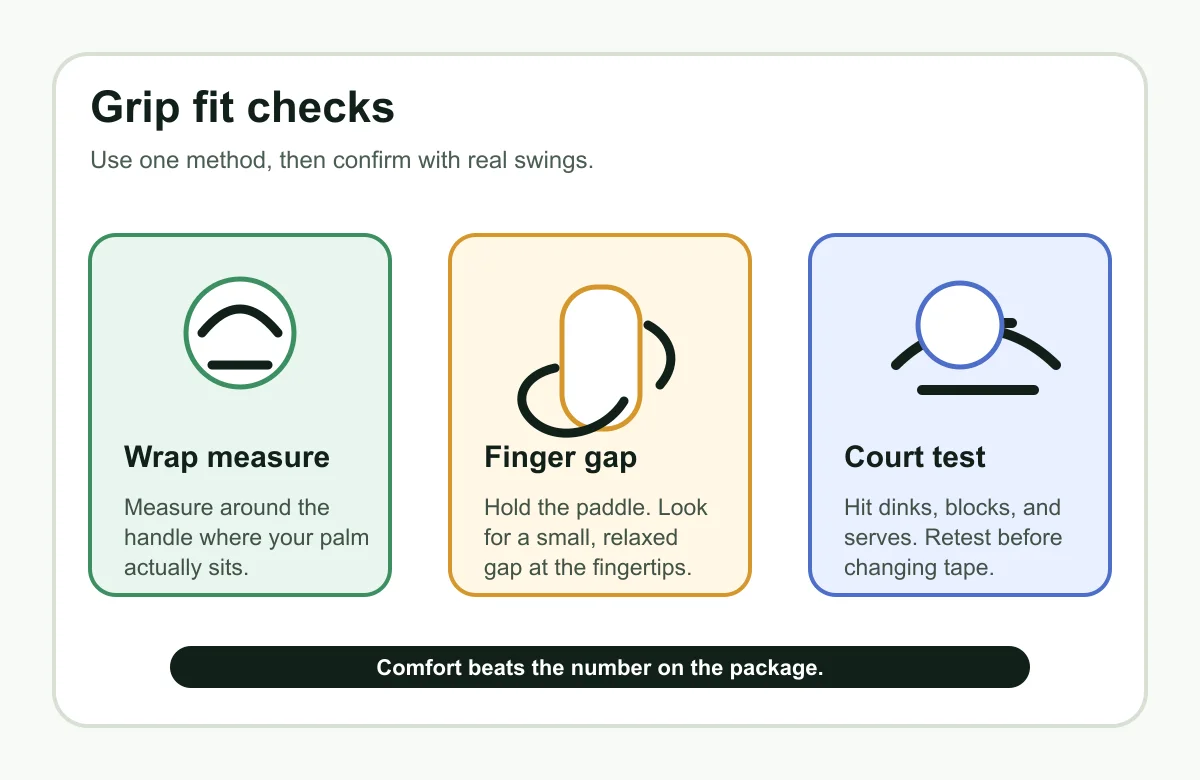
Estimated time: 5 minutes. Run this quick check before you buy a new paddle or start wrapping tape around the handle.
- Hold the paddle in your normal ready position. Keep your grip pressure light enough that someone could gently slide the paddle out of your hand.
- Look at the space near your fingertips. If your fingertips dig into your palm, the handle may be too small. If your fingers barely wrap around the handle, it may be too large.
- Try the index-finger check. With your paddle hand wrapped around the grip, see whether the index finger from your other hand can fit into the gap between fingertips and palm. Treat this as a rough check, not a rule.
- Make one change at a time. Add a single overgrip layer if the handle feels too thin. If it feels bulky, remove an overgrip or test a paddle with a smaller listed circumference.
Most players are better off making small changes than chasing a perfect chart number. Honestly, charts are useful only until the ball starts moving.
Measure the handle without overthinking it
Estimated time: 3 minutes. Measuring helps you compare paddles, especially when a brand lists grip circumference in inches.
- Wrap the soft tape around the handle. Measure where the middle of your palm rests, not at the butt cap or near the throat.
- Keep the tape snug, not crushed. Compressing a cushioned grip can make the number look smaller than it feels on court.
- Write down the current setup. Note whether the paddle has the stock grip only, one overgrip, or multiple layers.
- Compare only like with like. A cushioned replacement grip and a thin tacky overgrip can produce the same number but feel very different.
Test grip size on court, not just in your hand
Estimated time: 15 to 20 minutes. Court testing shows whether the grip lets you relax under real contact.
- Hit 20 soft dinks. A good fit lets you guide the face without squeezing the handle like a tool.
- Block 20 moderate drives. Watch for twisting. A small amount can be normal on mishits, but repeated twisting points to grip, sweat, paddle weight, or contact quality.
- Serve 10 balls. Notice whether the wrist moves naturally. A handle that feels too large often shows up here.
- Try resets and third-shot drops. If every soft ball pops up, the paddle may be too lively, your grip pressure may be high, or both.
- Repeat after one small adjustment. Add one overgrip, then repeat the same shots. Do not change the ball, paddle, and grip all at once.
Want a cleaner test? Use the same ball type each time. Our guide to indoor vs outdoor pickleball balls explains why bounce can make a paddle feel different.
Match grip size to paddle weight and handle feel
Estimated time: 10 minutes. Grip size never works alone. A grip that feels perfect on a light paddle may feel slow on a heavier one.
- Check paddle weight first. If your hand tires quickly, compare grip size with our guide on how to choose pickleball paddle weight.
- Think about swing feel. A heavier paddle with a large grip can feel steady but slow. A light paddle with a tiny grip can feel quick but twitchy.
- Account for handle length. Tennis players often like room for a longer hold or two-handed backhand habits, so our guide to paddles for tennis players may help if you are crossing over.
- Separate grip from paddle face feel. A soft, controlled face can hide a grip that is slightly wrong, while a poppy paddle can make a small grip feel jumpier. See graphite vs fiberglass pickleball paddle and 14mm vs 16mm paddle thickness for the bigger picture.
Beginner buyers should also compare grip fit against the broader first-paddle checklist in our best pickleball paddle for beginners guide.
Make small grip adjustments safely
Estimated time: 5 to 10 minutes. Start with reversible changes. Save permanent grip replacement for when you know what problem you are solving.
- Add one overgrip layer. Wrap it smoothly and avoid thick ridges near the butt cap.
- Retest the same shots. Use dinks, blocks, serves, and resets again, not a random rally where everything changes.
- Stop if the handle feels clumsy. More tape can reduce wrist freedom and slow hand speed at the kitchen.
- Replace worn grip material. A slick old grip can feel too small because you squeeze harder to stop slipping.
- Check shoes and movement if balance feels off. Paddle fit is easier to judge when your feet are stable. Start with special shoes for pickleball, then compare stability-focused picks such as pickleball shoes for seniors and pickleball shoes for wide feet.
Practice with the grip you plan to use
Estimated time: 20 minutes. Once a setup feels close, lock it in for a few short sessions before changing again.
- Run a control block. Use our pickleball drills for beginners and track whether your grip pressure stays relaxed.
- Practice serves with the same grip. If you are still learning legal contact and foot placement, review the current pickleball serving rules.
- Play a simple game to 11. Understanding pickleball scoring rules for beginners keeps the test from turning into stop-start confusion.
- Compare light and heavy paddles later. After grip fit feels stable, read lightweight vs heavyweight pickleball paddle to refine swing feel.
Quick Checklist
- Start with a relaxed hold, not a death grip.
- Check fingertip spacing before measuring.
- Measure at the part of the handle your palm actually uses.
- Add only one overgrip layer before retesting.
- Use the same balls and drills when comparing grip changes.
- Judge comfort, paddle-face control, and wrist freedom together.
- Confirm that any paddle you use for organized play appears on an appropriate official approval list.
The right grip size should make the paddle feel quieter in your hand. If you can hold it lightly, keep the face stable, and avoid constant squeezing, you are close. Make one adjustment, test it, and let your actual shots decide.
Frequently Asked Questions
What grip size should I use for a pickleball paddle?
Use the size that lets you wrap your fingers comfortably while leaving a small, relaxed gap near your palm. If the grip feels too thin, try one overgrip. If it feels bulky or slows your wrist, test a smaller handle.
How do I measure pickleball paddle grip size?
Wrap a soft tape around the handle where your palm rests, then note whether you are measuring the stock grip or a grip with overgrip layers. The number is useful for comparison, but court feel matters more.
Is a bigger pickleball grip better?
Not automatically. A bigger grip can feel stable, but too much circumference can limit wrist movement and make fast hand exchanges feel slower.
Can I make my pickleball paddle grip bigger?
Yes. Add one overgrip layer, smooth it down, and test the same shots again. Add more only if the first layer clearly improves control and comfort.
Does pickleball grip size affect control?
Yes, because grip size affects pressure, paddle-face stability, and wrist freedom. A grip that fits lets you hold the paddle lightly instead of steering every shot with tension.
Official sources: USA Pickleball equipment standards · USA Pickleball approved paddle list. Check current program pages before applying.