Rules
Singles and Doubles Pickleball Scoring, Made Clear
Clear up pickleball scoring singles vs doubles with score calls, serve rotation, side-out examples, and quick fixes for beginners.
If pickleball scoring singles vs doubles feels like a small rule change that somehow breaks your brain, you are not alone. The points work the same in regular side-out scoring, but the serve rotation and score call change enough to trip up new players. Once you separate those two ideas, the game gets much easier to track.
Use this as a court-side reset. You will learn what to say, where to stand, and why doubles adds that third number to the score.
| What you see | Likely cause | First move |
|---|---|---|
| You hear three numbers in doubles | The last number is the server number | Track whether server one or server two is serving |
| The server keeps switching sides in singles | The server scored a point | Use even score on right, odd score on left |
| A doubles team loses serve after one fault at 0-0-2 | The opening server starts as server two | Call side out after that first fault |
| A receiver thinks they scored | Regular scoring only awards points to the serving side | Call side out, not a point |
What you need before you keep score
- Set the game format, 30 seconds: Confirm whether you are playing singles or doubles before the first serve. Doubles is the default at many open-play courts, but singles follows a cleaner score call.
- Agree on side-out scoring, 15 seconds: Most recreational games still use traditional side-out scoring. That means only the serving side scores a point.
- Choose the first server, 30 seconds: Start the first serving side at 0-0-2 in doubles. In singles, call 0-0 and serve from the right side.
- Know the target score, 15 seconds: Games are commonly played to 11, win by 2. Some events use 15 or 21, also win by 2, so check before tournament play.
Pickleball scoring singles vs doubles: the core difference
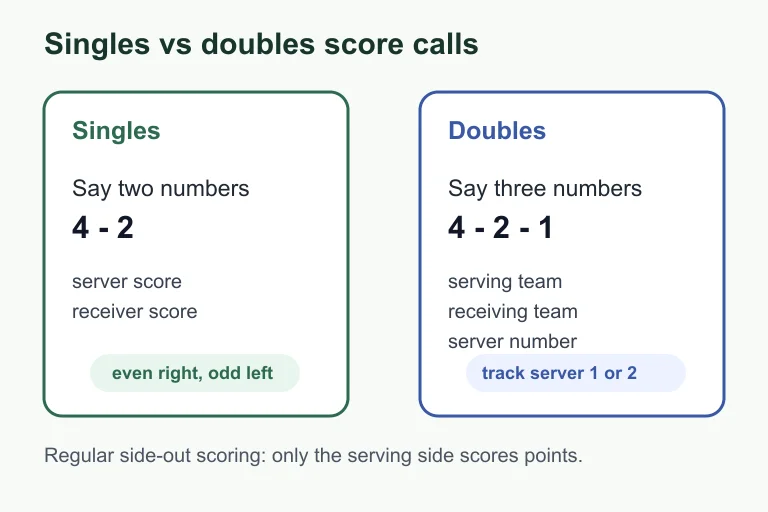
- Start with the same point rule, 1 minute: In regular scoring, the serving player or serving team is the only side that can win a point. If the receiving side wins the rally, it earns the serve instead.
- Strip singles down to two numbers, 1 minute: A singles score is called as server score, then receiver score. At 4-2, the server has 4 and the receiver has 2.
- Add the server number in doubles, 2 minutes: A doubles score is called as serving team score, receiving team score, then server number. At 4-2-1, the serving team has 4, the receiving team has 2, and the first server on that team is serving.
- Remember the opening exception, 1 minute: The first serving team in doubles starts at 0-0-2. Only one player serves before the first side out, which keeps the opening team from getting two full turns before the opponents touch the ball.
Honestly, most confusion comes from treating the third doubles number like another point total. It is not. It only tells everyone which partner is serving.
Call the score the right way
- Say your score first, 30 seconds: The server always calls their own score before the opponent score. If you are serving and leading 6-3 in singles, call 6-3.
- Use three numbers for doubles, 45 seconds: If your team is serving at 6-3 and you are the second server, call 6-3-2. Keep it loud enough for all four players to hear.
- Pause before serving, 15 seconds: Give the receiver a beat to catch the score. That tiny pause prevents half the arguments you hear in casual games.
- Correct it before the serve, 30 seconds: If someone disagrees with the call, stop and fix it before the ball is served. After the rally starts, you have made the problem harder.
Use court position to check the score
- Check singles first, 1 minute: In singles, serve from the right side when your score is even and from the left side when your score is odd. That rule alone catches many score mistakes.
- Use the starting server in doubles, 2 minutes: In doubles, the player who started on the right side for a team will be on the right when that team has an even score, and on the left when that team has an odd score.
- Track points, not rallies, 1 minute: Players switch service courts only after their side scores a point. If the serving side loses the rally, no point is added in regular scoring.
- Reset after side out, 1 minute: When service changes to the other team, the player on the right serves first if that team score is even. The player on the left serves first if that team score is odd.
Want a quick gut check? Look at the serving side score and the server position. If those two do not line up, stop before the serve and sort it out.
Play through a doubles example
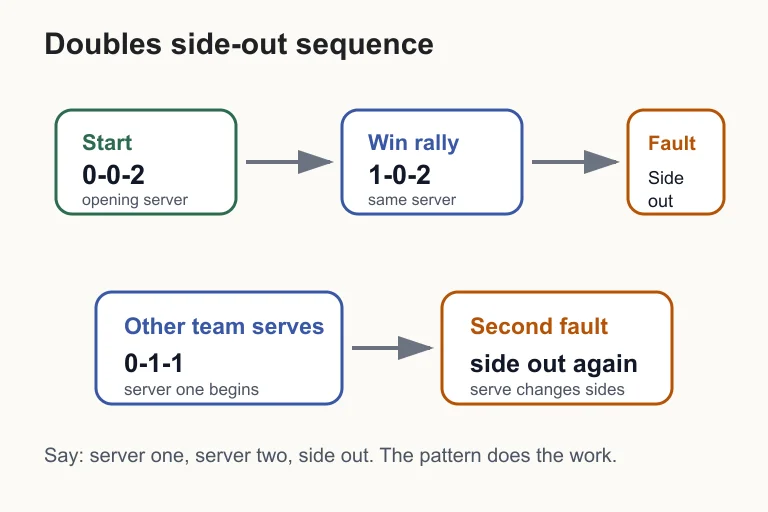
- Begin at 0-0-2, 30 seconds: Team A starts the game with one opening server. If Team A wins the rally, the score becomes 1-0-2 and that same server switches sides.
- Give the serve away after a fault, 30 seconds: If Team A then loses the rally, it is side out. Team B now serves.
- Start the new team on server one, 30 seconds: If Team B is serving at 0-1, the first partner serves and calls 0-1-1. If that partner faults, the second partner serves at 0-1-2.
- Call side out after server two faults, 30 seconds: Once server two loses a rally, the serve goes back to Team A. No point is awarded to Team A unless Team A was serving and won the rally.
At first, say the full sequence out loud. Server one, server two, side out. That rhythm sticks faster than trying to memorize a chart.
Play through a singles example
- Open at 0-0 from the right, 30 seconds: The first server begins on the right side because their score is even.
- Switch after scoring, 30 seconds: If the server wins the rally, the score becomes 1-0 and the server moves to the left side.
- Stay put after losing the rally, 30 seconds: If the server loses the next rally, the receiver gets the serve. No point is added to the receiver in regular scoring.
- Serve from the score side, 30 seconds: If the new server has 0, they serve from the right. If they later reach 1, they serve from the left.
Singles feels faster because there is no partner rotation and no server-one/server-two call. You only need the two scores and the even-right, odd-left habit.
Common scoring mistakes to fix quickly
- Mixing up server number and score, 1 minute: If a doubles call ends in 1 or 2, that last number is never a team score. Treat it as the current server label.
- Giving points to receivers, 1 minute: In regular scoring, receivers win the serve, not a point. Say side out and move service to the correct player or team.
- Forgetting the 0-0-2 start, 1 minute: The opening doubles team starts with server two. After that first side out, both partners on each side can serve on future turns.
- Standing on the wrong side, 1 minute: Use score parity as a position check. Even score means the correct starting-side player should be on the right for that team.
If your group is new, keep the mood light. Score mistakes happen because everyone is learning several habits at once: serving, rotating, calling lines, and remembering the double bounce rule.
Gear and practice links that make scoring easier
Scoring is easier when your serve and first few shots are steady. Start with a beginner serving routine, add home drills for beginners, and use these control-building drills when you get court time.
Footwork matters too. A short 8-minute warm-up routine can help you settle in before games, and knowing the difference between court shoes vs tennis shoes helps you move with more confidence.
For gear, start with the basics instead of chasing hype. Compare the paddle weight guide, choosing paddle weight, pickleball paddle shape guide, elongated or standard paddle, and paddle grip size before buying.
Need more paddle context? Check paddle surface grit, graphite vs fiberglass paddles, power paddle picks for beginners, budget paddles under $100, and how long pickleball paddles last.
Round out the rules side with common beginner mistakes, current serving rules, beginner scoring rules, and a quick look at indoor and outdoor balls.
Quick Checklist
- Call two numbers in singles and three numbers in doubles.
- Remember that only the serving side scores in regular side-out scoring.
- Start doubles games at 0-0-2.
- Use even score on the right and odd score on the left as your position check.
- In doubles, treat the last number as server one or server two.
- Pause before serving so every player hears the score.
- Check event rules if a tournament uses rally scoring.
Keep the score call simple and you will stop losing track in the middle of a rally. Singles asks for two numbers and side awareness. Doubles adds partner rotation, but the third number is only telling you who is serving.
Official sources checked: USA Pickleball Official Rulebook and USA Pickleball Rules Summary.
Frequently Asked Questions
how do you score singles pickleball?
Call the server score first and the receiver score second. In regular scoring, only the server can score a point. Serve from the right side when your score is even and from the left side when your score is odd.
why does doubles pickleball have three numbers?
Doubles uses three numbers because the last number identifies the current server. A call of 5-3-2 means the serving team has 5, the receiving team has 3, and the second server on that team is serving.
what does 0 0 2 mean in pickleball?
0-0-2 is the opening doubles score. It means neither team has scored and the first serving team starts as server two, so one fault creates a side out.
can the receiving team score in pickleball?
Under regular side-out scoring, no. The receiving side wins the serve when it wins a rally, but it does not receive a point. Rally scoring is different, so confirm the format before organized play.
is singles scoring easier than doubles scoring?
Yes, for most beginners. Singles has only two numbers and no partner serve rotation. Doubles adds server one, server two, and side-out tracking.