Training
Doubles Positioning for Beginner Pickleball Players
Learn pickleball doubles positioning beginners can use: where to stand after the serve, how to move together, and when to cover middle.
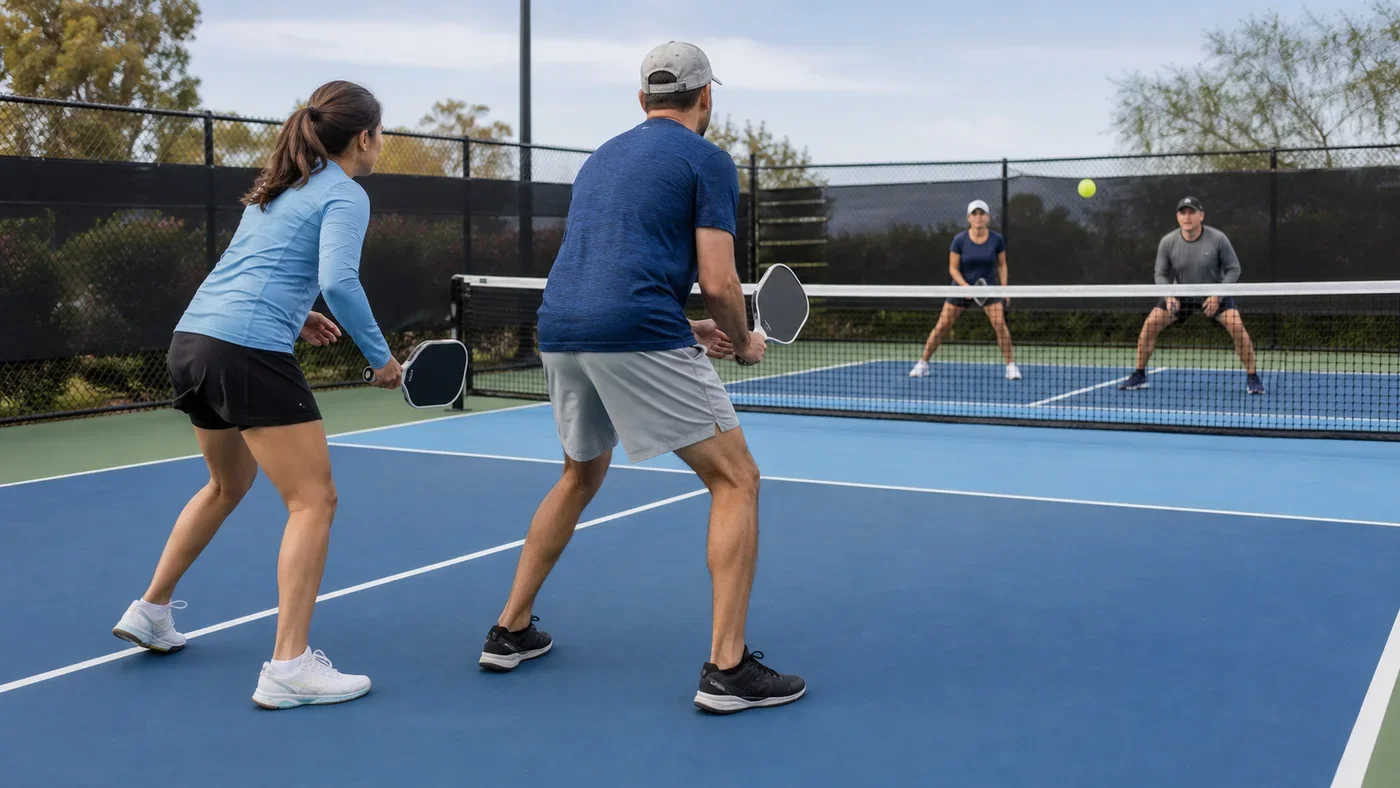
pickleball doubles positioning beginners can trust starts with one plain idea: move with your partner, not as two separate players chasing the ball. Most beginner points fall apart because one player rushes, the other freezes, and the middle of the court turns into free space for the opponents.
Think of doubles positioning as a shared shape. You and your partner want to climb from the baseline to the non-volley-zone line together, keep a workable gap between you, and decide who owns the middle before the ball is already there.
| What you see | Likely cause | First move |
|---|---|---|
| Both partners watch a middle ball | No call for who takes forehand-middle shots | Agree on "mine" and "yours" before serving |
| One player is at the kitchen, one stays back | The team moved forward at different speeds | Pause in transition until both can step up |
| Crosscourt dinks pull you wide | Partner does not slide to cover the center lane | Move like a connected pair, about a few steps apart |
| Third shots get attacked | Serving team rushes before the return bounces | Respect the two-bounce sequence, then advance |
| Lobs keep landing behind you | Both players crowd the line without reading paddle face | Split step and recover one player at a time |
Start by knowing your job on each side
Serving team and receiving team do not begin the rally with the same assignment. The receiver's partner can usually start near the non-volley-zone line, while the receiver waits back to return the serve. On the serving side, both players must allow the return to bounce before attacking, so patience matters.
USA Pickleball's rules summary explains the two-bounce rule and the non-volley zone, which is why beginner positioning cannot just mean "run to the kitchen." You earn that forward position by letting the serve and return bounce, then moving in behind a ball your team can control.
The simple doubles shape: side by side, not front and back
A strong beginner team usually looks like a shallow wall. Both players are near the same depth, with enough space to swing without crowding and close enough to protect the middle. That shape closes angles and gives each partner a clear lane.
Problems start when one player charges ahead while the other is pinned near the baseline. Opponents see the diagonal gap immediately. They can drop short, drive through the middle, or lob over the player who has stopped moving.
Aim for connected movement. If your partner slides left to follow a crosscourt dink, slide left too. If your partner backs up for a lob, do not stand frozen at the line hoping the next ball misses you.
How the serving team should move forward
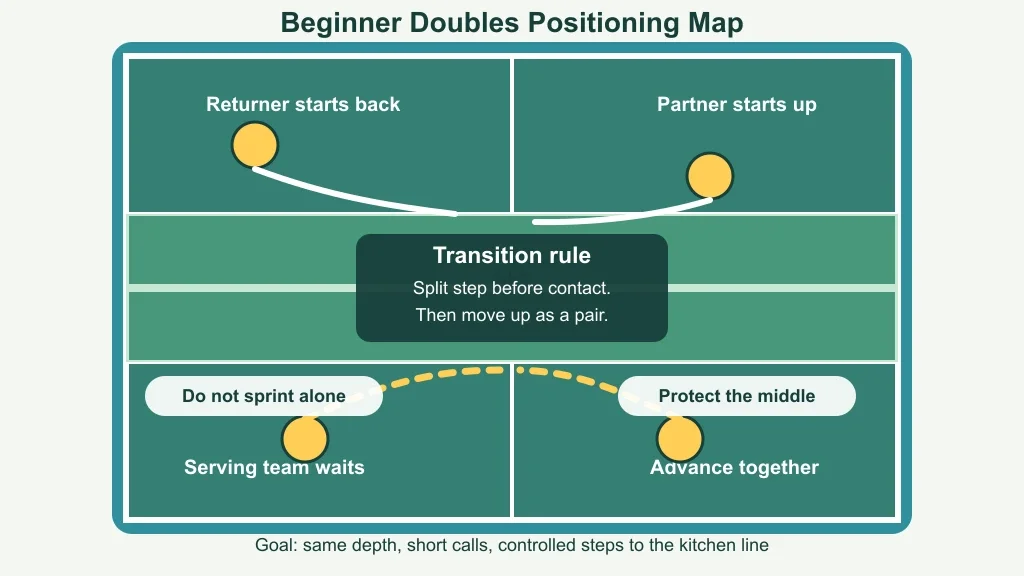
Serve from behind the baseline, then stay ready for the return to bounce. After that bounce, your team has a choice: drive, drop, or reset. A hard sprint to the kitchen after a weak third shot usually gives opponents an easy target at your feet.
Better movement looks like a controlled advance. Hit or watch the third shot, split step as the opponent contacts the ball, then move again if the ball gives you time. One or two balanced stops through the transition zone beat one rushed charge.
Beginners who want more context can pair this with our serve routine for beginners and the double bounce rule. Those two pieces explain why the first few seconds of a rally feel different from tennis.
How the receiving team should set up
Receiving has a built-in advantage because the returner can hit deep and then move forward while the serving team waits for the second bounce. Make the return high enough over the net, deep enough to keep opponents back, and simple enough that you can follow it in.
Returner's partner should stay alert near the non-volley-zone line without drifting into the middle too early. The returner should move up after the return, but not blindly. Watch the opponent's paddle and split step before they strike the third shot.
If you lose track of the score or server order, clean that up with singles and doubles scoring. Good positioning is easier when both partners know who serves, who returns, and which side each player should occupy.
Covering the middle without arguing
Middle balls cause beginner hesitation because both players feel responsible and neither wants to collide. Decide the default before the game gets tight. Many teams let the stronger forehand take most middle balls, but that is a team preference, not a law.
Use clear calls. "Mine" means you are taking it. "Yours" means you are leaving it. "Switch" means a lob or scramble has changed sides and both players need to reset their lanes.
Honestly, most beginner teams talk too late. Call as the ball leaves the opponent's paddle, not after it is already between you.
Where to stand at the kitchen line
Once both players reach the non-volley-zone line, keep your toes close to the line without stepping into a volley fault. Your paddle should be up, your knees should be soft, and your weight should be ready to move left, right, or back.
Do not stand glued to one spot. Slide with the ball. If the opponents dink crosscourt, the player in front of the ball shades wide while the partner protects the middle. If the ball comes back middle, the pre-agreed middle player takes it.
Touch shots become easier with gear that suits your swing. A control paddle shortlist, our paddle weight guide for beginners, and a look at paddle surface grit can help if the paddle feels jumpy in hand battles.
Surviving the transition zone
Many players call the space between the baseline and the non-volley-zone line "no man's land" because balls land at your feet there. Beginners hear that and try to avoid the area completely. That is not realistic.
Use the transition zone as a temporary stop, not a place to camp. If the ball is low, reset it softly and hold your balance. If your shot forces a weak reply, step in together. If opponents drive hard at your feet, block first and earn the next step.
Footwork is the unglamorous fix. Start with warm-up exercises for beginners, add a few pickleball drills at home, and make sure your shoes support lateral movement. Our guide to pickleball court shoes versus tennis shoes explains that part in more detail.
Shot choices that support better positioning
Positioning and shot selection feed each other. A deep return gives you time to move forward. A soft third-shot drop gives the serving team a chance to advance. A rushed low-percentage speedup often leaves both partners stranded.
Beginners should favor shots that buy time and keep the team connected. Deep returns, middle resets, and crosscourt dinks are not flashy, but they give your partner a chance to move with you.
For a broader plan, read beginner doubles pickleball strategy and common beginner mistakes. Those guides connect court position with serve choices, shot tolerance, and communication habits.
Gear notes that matter, and what can wait
No paddle fixes poor spacing. Still, beginner gear can make doubles positioning easier when it gives you predictable control on blocks, dinks, and resets.
If you are still choosing equipment, compare carbon fiber versus fiberglass paddle, the paddle shape guide, and whether an elongated or standard paddle shape fits your game. Budget players can start with budget paddle picks under $100 instead of overbuying.
Power sounds tempting, but beginners should be careful. A guide to power paddles for beginners can help, and paddle traits that help beginners learn spin matter once you can place the ball. Keep a basic paddle care routine too, and know when to replace a paddle if the face starts feeling dead.
Quick Checklist
- Know whether your team is serving or receiving before choosing your starting spot.
- Let the required early bounces happen before rushing forward.
- Move with your partner so you stay near the same court depth.
- Agree who takes most middle balls before the rally starts.
- Split step when opponents contact the ball, especially in transition.
- Slide with crosscourt dinks instead of reaching from a frozen stance.
- Use short calls: mine, yours, switch, up, and back.
Official sources checked
Official sources: USA Pickleball Official Rulebook · USA Pickleball doubles strategy tips.
Frequently Asked Questions
where do you stand in doubles pickleball?
Most of the time, both partners want to work toward the non-volley-zone line and stay near the same depth. At the start, receiving and serving teams set up differently because the serve and return must bounce before volleying is allowed.
who covers the middle in pickleball doubles?
Many teams let the stronger forehand cover most middle balls, but the best answer is whatever you and your partner agree on before the point. Use clear calls so both players do not swing or both let the ball pass.
should both players be at the kitchen line?
Yes, once the rally allows it and both players can arrive under control. Standing together near the kitchen line closes angles, but rushing there after a weak shot can leave balls at your feet.
how far apart should doubles partners stand in pickleball?
Stay close enough to protect the middle but far enough that each player has room to swing. The exact gap changes with the ball location, but beginners should think in terms of sliding together rather than holding fixed spots.
what is the biggest positioning mistake beginners make in doubles?
The biggest mistake is splitting depth, with one partner at the kitchen and the other stuck deep. That opens easy angles and makes both players guess who should take the next ball.
Bottom line
Better doubles positioning is not complicated, but it does require discipline. Move together, protect the middle, respect the early bounce rules, and use simple calls before the rally gets messy.